
A South American mammal
The scientific name remains Priodontes maximus. It belongs to the mammalian order Cingulata, within Xenarthra. The current American Society of Mammalogists’ Mammal Diversity Database places it in Tolypeutidae. Other sources still use Chlamyphoridae; Dasypodidae, used in the recovered article, reflects an older grouping.
Its broad range extends from northern South America through countries including Brazil, Bolivia and Paraguay to northern Argentina. It is not exclusive to Argentina, nor restricted to rainforest.
In Argentina, the national mammal assessment places it in the Chaco region of Chaco, Formosa, Salta and Santiago del Estero. This does not imply continuous occupancy throughout those provinces. SAyDS–SAREM’s 2019 assessment documents that distribution. Research in El Impenetrable National Park provides a recent confirmed example in Chaco.
Size and armour
The IUCN specialist group gives approximate head-and-body lengths of 75–100 cm, plus a 40–50 cm tail, and a weight range of 20–60 kg. These are descriptive ranges, not the dimensions of every adult; 60 kg should not be treated as a typical weight.
Its dark armour has a lighter lower edge, flexible bands and a plated tail. The elongated head has small ears, and the powerful forefeet are adapted for digging. The enlarged third foreclaw has been reported at about 20 cm measured along its curve—not every claw reaches that length.
Tooth counts vary and can reach around 100 or more. The count is not fixed, and there is no need to turn it into an absolute record claim. Carter, Superina and Leslie’s scientific species account describes its anatomy.
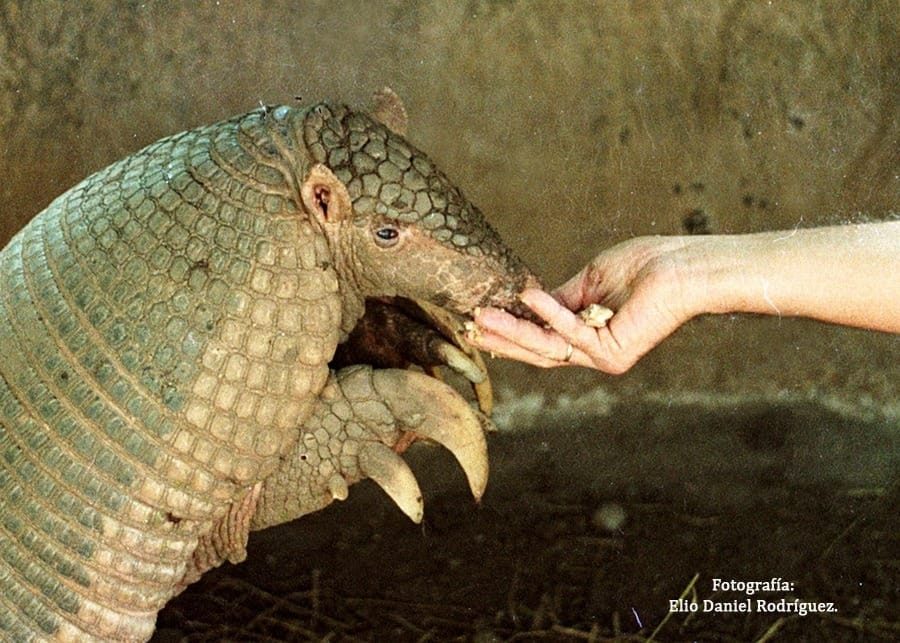
Original article photograph, credited in the image to Elio Daniel Rodríguez. The feeding scene does not illustrate natural foraging behaviour.
Habitat, food and behaviour
Giant armadillos use forests and savannas, including dry habitats. They are primarily nocturnal and dig burrows. Their main food is ants and termites, with other invertebrates eaten occasionally. They do not follow a fixed daily travel distance or necessarily consume an entire termite colony.
Adults are generally described as solitary outside mating and maternal care. Females usually have one young, with prolonged care and nursing. A fixed summer mating season is not established here. The burrows also provide shelter used by other wildlife. The IUCN specialist group’s account summarizes current ecological knowledge.
Conservation in Argentina and beyond
The global IUCN category is Vulnerable. Argentina’s 2019 national assessment lists the species as Endangered, while the national 2021 categorization uses En peligro de extinción. These concern different geographical scales. Argentina’s National Parks biodiversity system lists the assessments separately.
Documented threats include habitat loss and fragmentation, agricultural land conversion, hunting, vehicle collisions and wildfire. Their importance varies across the range. No reliable total population count is supplied here: the species’ broad distribution should not be mistaken for abundance.
Keeping suitable habitat connected and understanding the animal’s needs remain important to its conservation. Precise local population sizes and aspects of its life history still require research.